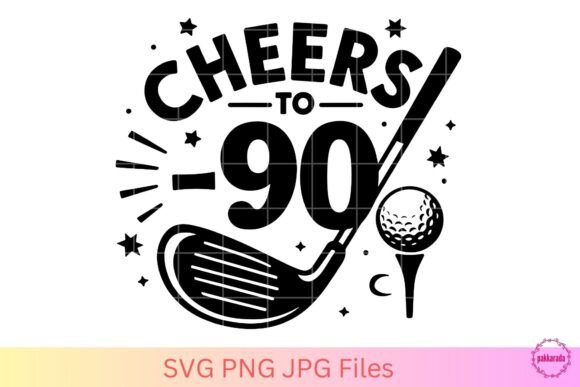
Cheers to -90 Golf Score Funny Golfer
As a designer who spends half my life digitizing vectors and the other half troubleshooting thread jams, I don’t just look at an embroidery file; I look at how it behaves under the needle. When evaluating Cheers to -90 Golf Score Funny Golfer, I am looking past the novelty of the text to assess its viability as a commercial asset or a meaningful personal gift. This design is marketed within the T-Shirt Designs and Graphics categories, but for the serious embroiderer, those labels are secondary to stitch quality, visual balance, and marketability.
The concept itself—a humorous nod to a golfer’s score—is a classic niche. It taps into the specific humor of golfers who might joke about their performance while simultaneously celebrating a milestone, such as a 90th birthday. The juxtaposition of a terrible golf score with a significant age marker creates an immediate emotional hook. For an Etsy seller or small business owner, this kind of relatable, slightly self-deprecating humor often outperforms generic inspirational quotes because it sparks conversation in photos and social media shares.
First Impressions and Visual Personality
When I first loaded the files for Cheers to -90 Golf Score Funny Golfer, my eye was drawn to the layout hierarchy. The text needs to carry the weight of the joke without feeling cluttered. In many low-quality digital products, the typography fights for attention against unnecessary decorative elements. Here, the focus remains on the message. The mood is lighthearted and celebratory, which makes it versatile. It isn’t strictly for a stern professional golfer; it’s for the hobbyist who laughs at their own game.
Visually, the design feels balanced. Whether intended for a chest placement on a sweatshirt or centered on a tote bag, the negative space around the lettering allows the eye to rest. This is crucial for readability. A design that is too dense can become a muddy blob after stitching, especially if the recipient has limited vision due to age—another reason why this design works well for a 90th birthday theme. The clarity of the font choices suggests that the designer prioritized legibility over overly ornate flourishes, which is a smart move for mass production or quick turnaround orders.
Real-World Application: From Screen to Stitch
Let’s talk about where this design actually lives in your product catalog. I envision Cheers to -90 Golf Score Funny Golfer performing exceptionally well on custom apparel. A heather grey crewneck sweatshirt embroidered with this design hits the sweet spot of comfort and style. The texture of the fleece provides a forgiving background for the stitches, allowing the thread colors to pop without the fabric showing through.
However, the versatility extends beyond standard tees. Consider a personalized gift scenario: a mother or father turning ninety loves golf, perhaps not very well. A custom embroidered patch applied to their favorite cap becomes a cherished item. Or, imagine a kitchen towel for a home that values humor. The design translates well to flat goods like aprons or tea towels, where the rectangular canvas accommodates the horizontal flow of the text perfectly. For the craft fair vendor, placing this on a sturdy tote bag design offers a practical souvenir that guests will actually use, keeping your brand visible long after the event.
In the realm of baby embroidery, this might be less applicable unless it is a "future golfer" theme, but for adult merchandise, it shines. It fits naturally into holiday embroidery collections as a quirky stocking stuffer or a gag gift for Father’s Day. The key here is presentation. When you create printable mockups for your Etsy listings, ensure you show the design on fabrics that match the vibe—soft cottons, durable poly-blends, and textured linens. Buyers need to visualize the finished product before they commit.
Where Caution Is Required
No design is perfect for every surface. As you prepare to produce items using Cheers to -90 Golf Score Funny Golfer, there are specific areas where you must exercise judgment. Small hoop sizes can be tricky. If the design contains intricate details or tight curves in the lettering, shrinking it down may cause the satin stitch to pucker or the fill stitch to lose definition. Always test the design in black and white mockups at various scales to check for contrast issues.
Fabric texture plays a massive role in the final outcome. On highly textured fabrics like heavy wool or loose-weave linen, fine details can get lost. Similarly, stretchy fabrics require careful hooping and potentially a cut-away stabilizer to prevent distortion. If you are working with dark fabric, ensure your thread colors provide enough contrast. A light yellow thread on a navy blue shirt might disappear, ruining the visual appeal. Conversely, using white thread on a white shirt is rarely a good idea unless you are doing a tonal effect, which requires precise tension control.
Avoid placing this design on curved surfaces like baseball caps unless you have specialized equipment and experience. The curvature can distort the text, making the "-90" look skewed or unreadable. Additionally, be mindful of dense stitch areas. If the design relies heavily on fill stitch, running it on thin fabric without adequate stabilizer will result in puckering. This is particularly important for commercial embroidery projects where consistency is key to maintaining customer trust.
Designer Notes for Execution
To get the most out of this embroidery file, follow these practical steps. First, always test the design on scrap fabric that matches the weight and composition of your final product. This helps you dial in your tension settings and choose the right stabilizer. Check the thread color contrast by holding your thread spools up to the fabric sample. Does the design jump off the material, or does it blend in too much?
Inspect the small details closely. Are the corners of the letters sharp? Is the spacing between words consistent? These subtle elements separate a professional-looking garment from a amateur one. If the design includes applique elements, ensure your cutting is precise before stitching the satin stitch border. For running stitch accents, verify that the stitch length is appropriate for the fabric type to prevent skipping.
Confirm whether the design works for both personal and commercial projects. Licensing terms vary, and as a small shop product creator, you need to know if you are allowed to sell finished items made with this file. If the license is unclear, reach out to the creator or assume it is for personal use only until clarified. This protects your business from potential legal issues.
Final Verdict on Value and Appeal
Cheers to -90 Golf Score Funny Golfer succeeds because it understands its audience. It is not trying to be high art; it is trying to be funny, relatable, and commemorative. For the digital product seller, this means higher conversion rates because the buyer immediately understands the joke. For the handmade product maker, it means fewer returns and happier customers who feel seen.
The design assets provided—SVG, PNG, and JPG files—offer flexibility for different workflows. While the primary use is machine embroidery, having vector files allows you to scale the design for screen printing or vinyl cutting if needed, expanding your service offerings. The transparent PNG with high resolution is excellent for creating realistic previews online, helping buyers see exactly what they are getting.
Ultimately, this design adds value to any craft business. It encourages engagement because people love sharing gifts that make them laugh. Whether it ends up on a sweatshirt, a pillow cover, or a kitchen towel, the core element is the connection it fosters. By paying attention to stitch density, fabric choice, and proper stabilization, you can transform this digital file into a tangible, memorable piece of art that stands the test of time—and frequent washing. For the savvy entrepreneur, it is a solid addition to the inventory, ready to turn a simple golf joke into a profitable, heartfelt gesture.